
About Performing On-The-Fly Topology Corrections
Breaklines can sometimes create problems for the triangulation algorithms if topological errors occur within the geometry. Topological errors include dangles, crossings, and overshoots. These are illustrated in the following diagram:Common Topological Errors
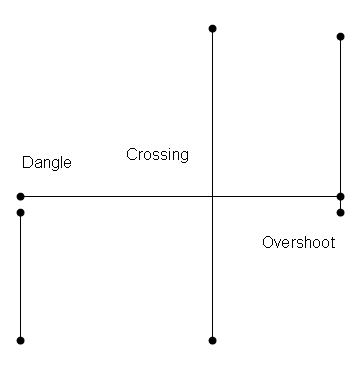
Common topological errors are generally present when using more than one breakline source layer. Although these errors can occur when using one layer, multiple layers typically are not collectively topologically correct and are the culprits behind crashes in the triangulation engine resulting in surfaces or contours that are not correct or fail to complete the surface all together.
When using the on-the-fly topological corrections, these errors are fixed in memory for the purpose of completing the triangulation. Any edits made to the geometry is performed in memory and does NOT change the underlying data. Common errors are fixed to represent the following set of connected line segments:
Fixed Topological Errors
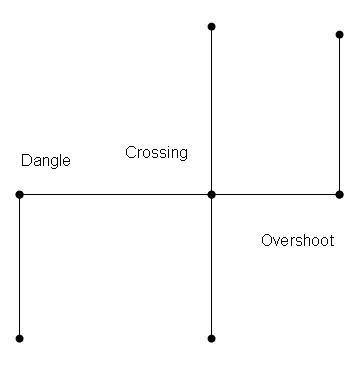
Although not necessary to use, automatic topology corrections are highly recommended when using more than one breakline source without knowing if the sources are collectively topologically correct. This is recommended because multiple layers are generally not topologically correct to one another as opposed to the geometry within a single layer.
Automatic topological corrections does decrease performance of the dynamic surface engine. Therefore, it is not recommended for use if the breaklines are known to be topologically correct with each other.
