About the Standard Deviation Value
Standard deviation is a measure of variance or dispersion of values
from a mean or average. It describes how a set of values such as elevations
are distributed from a central value commonly called the average or
mean. If outliers (values either much higher or lower than the other
values) are present in the distribution of elevations, then the standard
deviation of the values is higher than if the outliers were not present.
Using the standard deviation method of calculating
the minimum and maximum values reduces the effect of
skew
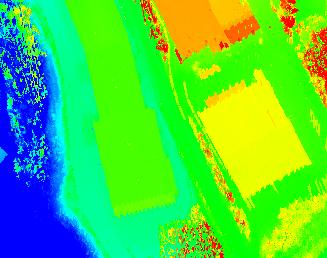
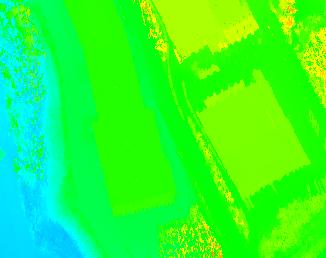
in the distribution of colors. If the distribution of elevation values
has outliers that visually affect the color distribution, a low standard
deviation value such as 2 will produce better results. If the visual
effect of the outliers is not as significant, then a higher standard
deviation value such as 3 or 4 are likely applicable values.
Using low standard deviation values when outliers
are not as prominent in the elevation values, will result in using
too much color on either end of the spectrum. In contrast using high
standard deviation values when outliers do have a significant impact
on the distribution of colors will result in not enough colors on
the ends of the spectrum.
Example of the effect of standard deviation
| Standard Deviation
= 2 |
Standard Deviation
= 4 |
 |
 |
How to Modifying the Standard Deviation Value
Standard Deviation Text Box 
1. Open the Properties dialog.
2. Select the 'Symbology' tab and the 'Elevation' tab within it.
3. With the "Standard Deviation" type method selected,
input a value greater than zero.
Selecting
the Standard Deviation type method
