Overview
When surveying cables or powerlines, the quality of the results depends mainly on three factors:
- Distance from the cable
- Number of points or Pulse Repetition Rate
- Survey angle and coverage strategy
This article explains how these factors affect powerline capture, using the TVGO Neo, TVGO 116 and TVGO 132 as examples.

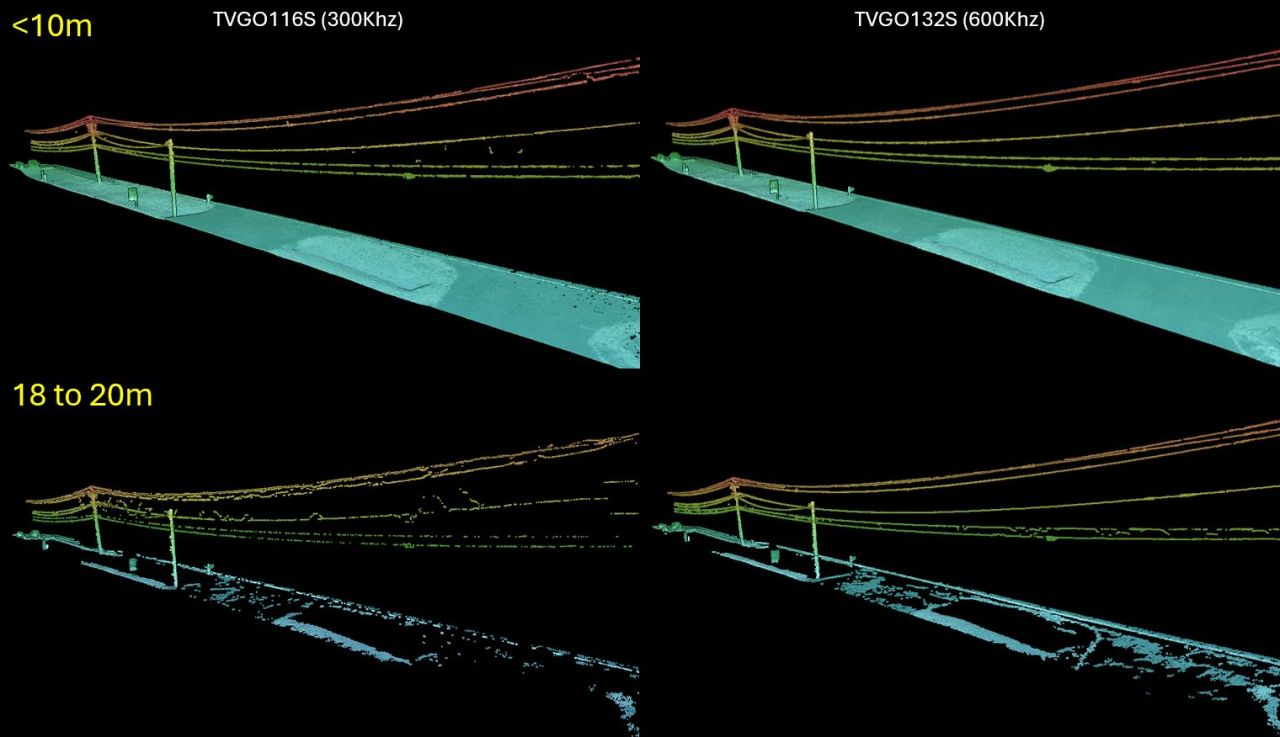

In this comparison, the TVGO Neo and TVGO 116 operate at 300 kHz, while the TVGO 132 operates at 600 kHz, allowing it to emit more laser pulses and capture more points on thin objects such as powerlines. Effective range also matters: the TVGO Neo reaches 40 m, the TVGO 116 80 m, and the TVGO 132 120 m. Overall, the higher PRR and longer range of the TVGO 132 provide better cable coverage, especially at greater distances.
Distance: 0 to 10 meters
When surveying at a short distance, between 0 and 10 meters, the distance from the cables is low enough for both sensors to collect the powerlines successfully.
In this situation, the user is usually walking directly below the powerline or very close to it. Because the cables are close to the sensor, the number of points collected is sufficient, even with a lower PRR sensor. At short distances, the PRR difference is less critical because the sensor is close enough to capture the cables with sufficient point density. However, range is still important, as the TVGO Neo has difficulties surveying the thinner cables of the powerline.
Distance: 15 to 18 meters
When the user walks parallel to the powerline from the other side of the road, the distance to the cables increases to around 15 to 18 meters.
At this distance, collecting cables becomes more challenging, especially because powerlines are thin objects and the survey is being performed from the side. The farther the sensor is from the cable, the fewer points are likely to hit the cable.
This is where PRR becomes more important. A sensor operating at 600 kHz, such as the TVGO 132, has a higher chance of collecting enough points on the cables than a sensor operating at 300 kHz, such as the TVGO 116. The TVGO Neo is even more limited in this scenario, as its lower PRR combined with its shorter range makes it difficult to properly survey the cables.
Survey Angle
Distance is not the only factor that matters. The angle of incidence also plays an important role.
When surveying powerlines from the side, distance becomes more critical. The cables are thin, and the sensor has fewer opportunities to hit them directly.
However, when surveying the cables perpendicular to the powerline or from the front, distance becomes less relevant.
Practical Recommendations
For better powerline survey results:
- Survey as close to the cables as safely possible.
- Try to stay within 0 to 10 meters when possible.
- Use double coverage when surveying from the side or from longer distances.
- Use a higher PRR sensor when surveying thin objects such as cables from more than 10 meters away.
- Avoid relying on a single pass when the cables are far from the sensor.
- When possible, survey the cables from the front or perpendicular to the line instead of only from the side.